Appendix: Key Empirical Anchors (as of February 2026)
Hardware Milestones
Google WillowDec 2024
- 105 superconducting qubits.
- First below-threshold surface code QEC.
- Distance-7 code with 0.143% error per cycle.
- Logical qubit lifetime 2.4× best physical qubit.
- Error suppression factor Λ = 2.14 ± 0.02.
- Published in Nature (doi: 10.1038/s41586-024-08449-y[4])
Quantinuum HeliosNov 2025
- 98 trapped-ion qubits.
- 94 error-detected logical qubits using [[4,2,2]] Iceberg code (distance-2 detection via post-selection, not active error correction).
- 48 logical qubits at 2:1 encoding ratio via code concatenation.
- 99.921% two-qubit gate fidelity.
- 99.9975% single-qubit gate fidelity.
- Real-time error detection with NVIDIA Grace Hopper GPUs.
- $10B valuation, $800M funding round
Microsoft Majorana 1Feb 2025
- 8 topological qubits claimed.
- First topoconductor.
- Nature publication (doi: 10.1038/s41586-024-08445-2[5]).
- Claims disputed by physicists at APS Global Physics Summit 2025 and in Nature commentary
DARPA US2QC final stage selected.
IBM NighthawkNov 2025
- 120 qubits, 218 tunable couplers, square lattice.
- 5,000 two-qubit gate capability
IBM LoonNov 2025
- 112 qubits, experimental, demonstrates all hardware elements for fault-tolerant computing including c-couplers and real-time qLDPC decoding (<480ns, 10× speedup).
- 300mm wafer fabrication
PrincetonNov 2025
- Transmon qubit >1ms coherence time.
- 3× previous record.
- 15× industry standard
IonQ/AnsysMar 2025
- Reported 12% speedup on a single medical device simulation instance[3] using 36-qubit IonQ system vs. classical HPC.
- Result not independently replicated; classical baseline not independently verified; commercial significance of margin uncertain given quantum compute cost premium
Market Data
| Metric | Data |
|---|---|
| Global QC Market | ~$3.5B (2025), projected $20B+ by 2030 (MarketsandMarkets[2]) |
| McKinsey | up to $97B quantum technology revenue by 2035, $28–72B from quantum computing (range) Note: these are top-down consulting estimates, not bottom-up revenue models; the upper end of the $28–72B QC range would exceed the current global HPC market of ~$50-60B; consulting-firm tech projections have a poor historical track record for emerging technologies |
| Equity Funding | $3.77B first 9 months 2025 (~3× 2024 full year) |
| Gov. Commitments | >$10B globally by April 2025 |
| PQC Market | $1.9B (2025), projected $12.4B by 2035 |
Roadmap Targets
Quantinuum
Sol (192 physical qubits, 2027)
Apollo (thousands physical, hundreds logical, fault-tolerant, 2029)
IBM
Kookaburra (modular logical storage, 2026)
Cockatoo (multi-chip entanglement, 2027)
Starling (200 logical qubits, 100M gates, 2029)
roadmap through 2033
Google
Error-corrected useful computation by end of decade; long-term million-qubit fault-tolerant target
Microsoft
Topological qubit array
million qubits on single chip (long-term);
DARPA QBI evaluation underway
DARPA QBI
11 companies in Stage B; goal: determine if utility-scale quantum computing achievable by 2033
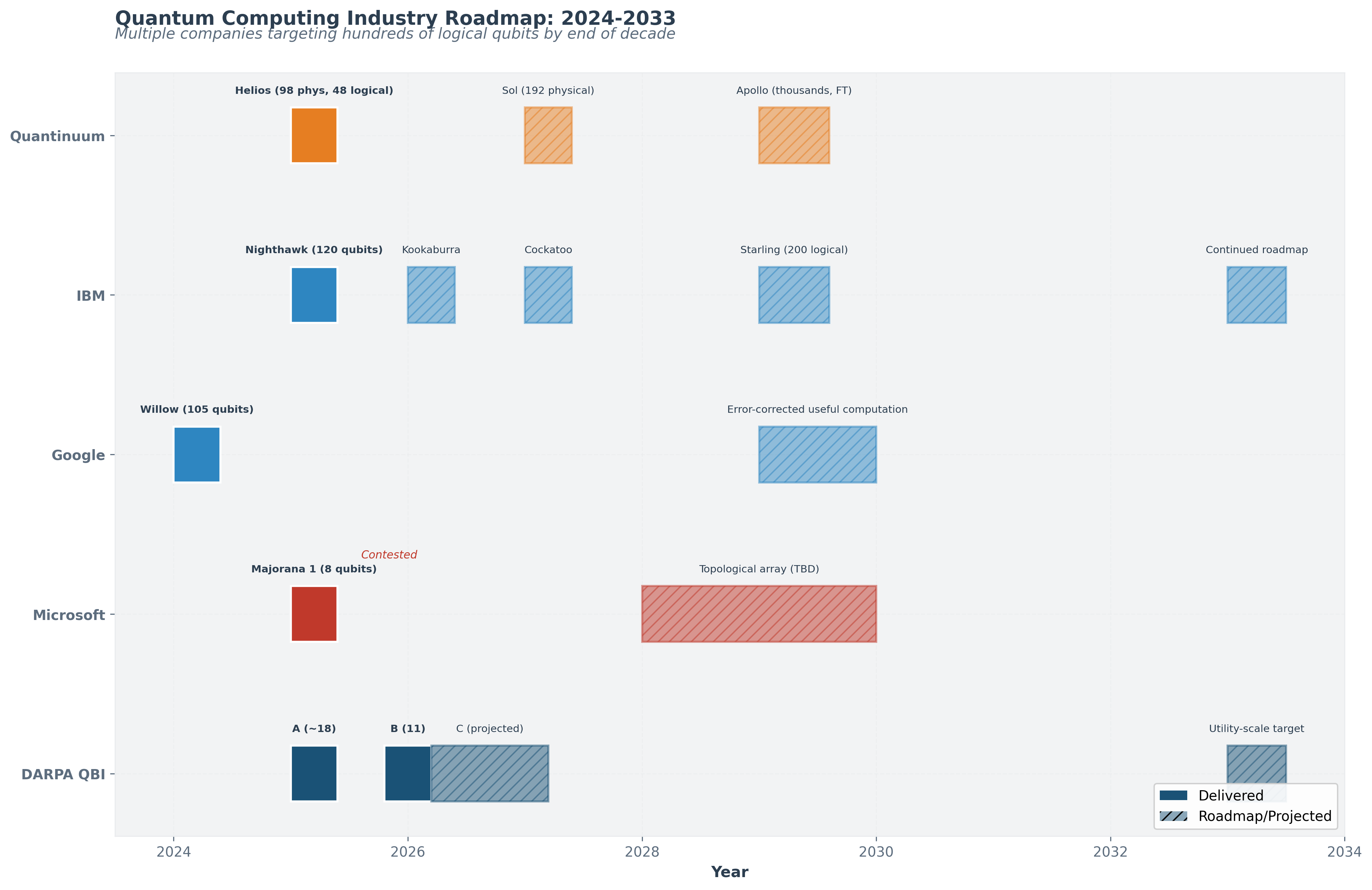
Multiple companies targeting hundreds of logical qubits by end of decade. Hatched bars represent roadmap targets.
Notes
- Quantinuum, 'Introducing Helios: The Most Accurate Quantum Computer in the World,' quantinuum.com (November 2025). ↩
- MarketsandMarkets, Quantum Computing Market Report (2025). ↩
- IonQ/Ansys, reported 12% speedup on medical device simulation using 36-qubit Forte Enterprise system (March 2025). ↩
- Acharya, R. et al., 'Quantum error correction below the surface code threshold,' Nature 638, 920–926 (2025). [link] ↩
- Aghaee, M. et al., 'Interferometric single-shot parity measurement in an InAs–Al hybrid devices,' Nature 638, 651–655 (2025). [link] ↩
- McKinsey & Company, Quantum Technology Monitor 2025. ↩
- Bain & Company, Technology Report 2025: quantum computing market analysis. ↩
- APS Physics, 'Microsoft's Claim of a Topological Qubit Faces Tough Questions,' APS Global Physics Summit (March 2025). ↩