Chapter IV: The Endgame Scenarios — 2025–2035
The following three scenarios are grounded in specific technical assumptions and bounded by the trendlines documented above. Each includes falsifiable near-term predictions.
Methodology note: The probability weights assigned below are the author's subjective estimates based on the trendline data and expert commentary surveyed for this report. They are not derived from a formal model, expert elicitation process, or historical base rate analysis. Readers should note that the combined 70% probability assigned to favorable outcomes (Scenarios A and B) is arguably optimistic relative to historical base rates for deep-tech commercialization timelines—analogous technologies (autonomous vehicles, nuclear fusion, gene therapy) have typically taken 2-3× longer than initial projections suggested, and experienced extended "winters" that the 30% plateau scenario may underweight.
Rather than predicting a single future, this chapter presents three scenarios: a base case, an optimistic case, and a pessimistic case. For each, we identify what to watch in the near term to tell which scenario we're actually in.
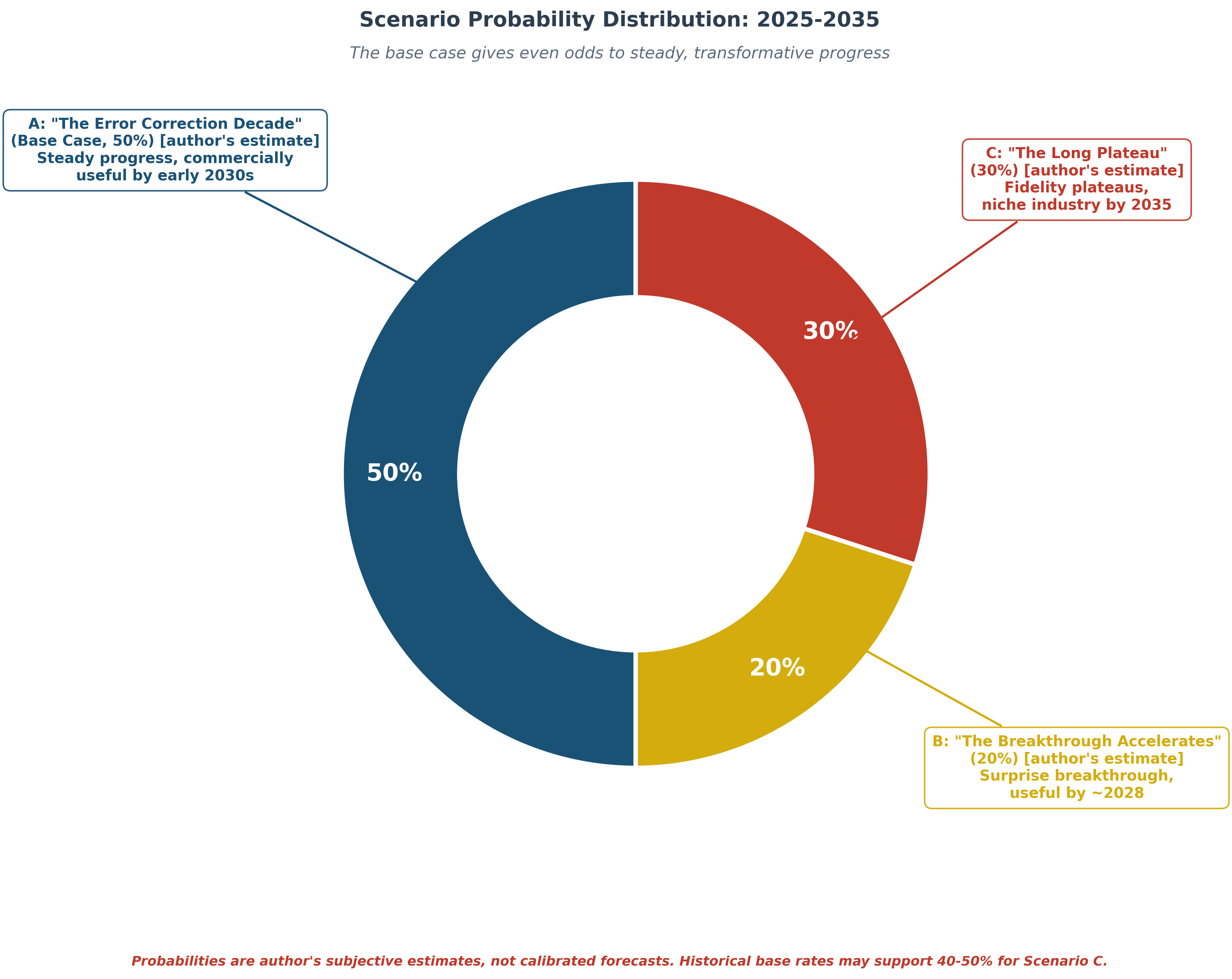
Probabilities are author's subjective estimates, not calibrated forecasts. Historical base rates may support 40-50% for Scenario C.
Scenario A: "The Error Correction Decade" (Base Case, ~50% Probability)
Technical assumptions: Error correction overhead continues to fall through a combination of improved gate fidelities (reaching ~99.99% by 2028 in at least one modality), better codes (qLDPC, code concatenation), and scaling of demonstrated approaches. No single dramatic breakthrough, but steady accumulation of improvements.
2026–2027: First credible demonstrations of quantum advantage on practical problems—most likely in quantum simulation of molecular systems (drug candidates, catalyst design) or certain optimization problems. These advantages will be narrow: specific problems, specific instances, modest speedups over the best classical methods. IBM targets quantum advantage by end of 2026. Classical counterarguments will be vigorous. Quantinuum Sol (192 physical qubits) deployed.
2028–2029: Fault-tolerant machines with 100-200 logical qubits become available (Quantinuum Apollo-class, IBM Starling). These machines can run algorithms of genuine scientific interest—simulating small drug molecules, modeling materials with strong quantum correlations, certain cryptographic applications. Revenue begins to grow beyond cloud access fees. DARPA QBI Stage C evaluations underway.
2030–2032: 500-1,000 logical qubit machines operating at error rates below 10⁻⁶. First commercially valuable quantum simulations—drug candidates that could not have been identified classically, materials with novel properties. Quantum computing is a recognizable (if small) industry generating $5-10 billion annually. Multiple companies achieve profitability on quantum-as-a-service.
2033–2035: 1,000+ logical qubit machines are standard tools in pharmaceutical R&D and materials science. Total value creation reaches $10-50 billion per year. The cryptographic threat from quantum computing remains 10+ years away for RSA-2048 breaking.
The base case: steady, unglamorous progress. No "Eureka!" moment, but quantum computers gradually become useful for specific problems that supercomputers can't solve, then become routine tools in pharma and materials science. Encryption remains safe for a long time.
Near-term confirmations (2026–2027)
Two-qubit gate fidelities reach 99.95%+ in at least two modalities. Quantinuum Sol ships on time with 192+ qubits. IBM's Kookaburra demonstrates modular logical qubit storage. At least one peer-reviewed demonstration of quantum advantage on a commercially relevant problem survives classical challenge for 12+ months.
Scenario A — April 2026 status: Two of the four 2026–2027 signposts are partially met; the two that landed are the less demanding. Logical-below-physical crossover: Quantinuum demonstrated active error correction on 48 Helios logical qubits at logical gate errors ~1×10⁻⁴, below the raw physical error rate (reported March 10, 2026 — peer review pending)[2]. Reproducible advantage: Google's Quantum Echoes demonstration on Willow (October 22, 2025; missed at the February 2026 cutoff and captured in this April 2026 refresh) is a 13,000× speedup over the best known classical algorithm running on Frontier on an out-of-time-ordered-correlator benchmark, reproducible on another quantum device — unlike the 2019 and 2024 random-circuit-sampling claims[3]. The two remaining signposts — Quantinuum Sol (192+ qubits), IBM Kookaburra modular logical-qubit storage, and peer-reviewed quantum advantage on a commercially relevant problem — remain unmet. Base case probability unchanged at ~50%; Q1 data flow is directionally supportive but within the bounds of the original forecast.
Scenario B: "The Breakthrough Accelerates" (~20% Probability)
Technical assumptions: A hardware or algorithmic surprise dramatically reduces error correction overhead beyond current projections. Candidates include: topological qubits proving out (Microsoft’s approach validated by independent groups), QuEra-style 100× overhead reduction[1] techniques working at scale, a novel qubit modality emerging from a national lab, or a fundamentally new error correction code that changes the math.
2027–2028: 500+ logical qubit machines available, three to five years ahead of the base case. Revenue cycle kicks in faster as pharmaceutical and financial companies begin using quantum simulation for genuine competitive advantage. Government involvement intensifies, with national security agencies accelerating quantum programs.
2028–2030: 1,000+ logical qubit machines. The materials-discovery feedback loop begins to close: quantum computers identify better qubit materials, which improve quantum computers. Quantum + AI convergence accelerates. The cryptographic threat timeline compresses significantly; PQC migration becomes urgent for all organizations.
The optimistic case: a surprise breakthrough accelerates everything by several years. Useful quantum computers arrive sooner than expected. This is the scenario where the cryptographic threat moves from "you have plenty of time" to "you should have started migrating yesterday."
Near-term confirmations (2026–2027)
Microsoft's topological qubit claims validated by independent replication, OR QuEra's overhead reduction demonstrated on a production system, OR a surprise announcement of a novel high-fidelity qubit modality with inherent error suppression.
Scenario B — Q1 2026 status: No Microsoft independent replication, no QuEra production-scale overhead demonstration. Infleqtion's 100-qubit Sqale deployment at the UK NQCC (March 2026) at 99.73% two-qubit fidelity is a neutral-atom scaling data point but remains below the 99.95% fidelity threshold this scenario requires[4]. NVIDIA's April 2026 Ising open AI decoders (2.5× faster, 3× more accurate than pyMatching) compress calibration and decoding cycles across modalities—consistent with but not sufficient for the scenario[5]. No acceleration signal yet.
Scenario C: "The Long Plateau" (~30% Probability; historical base rates for deep-tech commercialization may support 40-50%)
Technical assumptions: Gate fidelities plateau at approximately 99.95%—good but insufficient for cost-effective error correction at scale. The overhead wall proves harder to break than hoped. qLDPC codes turn out to require connectivity that is impractical at scale. Code concatenation approaches hit diminishing returns. Classical algorithms continue to improve and erode quantum advantage claims.
2027–2029: Error-corrected machines remain at 50-100 logical qubits. Quantum advantage claims continue to be contested. The revenue cycle fails to materialize at scale. Some quantum startups fail or consolidate. Investment cools but does not collapse.
2030–2035: Useful logical qubit counts grow slowly—100 usable logical qubits not achieved until 2033+. Quantum computing becomes a niche $5-10 billion industry by 2035, valuable for specific applications (quantum sensing, quantum communications, quantum annealing for optimization) but not the transformative general-purpose computing platform some predicted.
The pessimistic case: progress stalls just short of where it needs to be, and regular computers keep eating into quantum's advantages. Quantum computing becomes a real but niche industry—like how nuclear fusion has been "20 years away" for decades: real physics, real progress, but practical payoff perpetually out of reach.
Near-term disconfirmations (2026–2027)
Two-qubit gate fidelities remain below 99.95% across all modalities by end of 2027. No credible quantum advantage demonstration survives classical challenge. DARPA QBI downgrades multiple companies from Stage B. Major quantum companies miss roadmap milestones by 12+ months.
Scenario C — Q1 2026 status: No Stage B downgrades have been announced; DARPA QBI evaluations remain underway through 2026. No major quantum company has missed a public roadmap milestone by 12+ months in the window since the report's February 2026 cutoff. Conversely, classical competition continues to tighten: every logical qubit milestone is matched by improvements in AI/GPU-accelerated tensor-network simulation. No scenario-disconfirming signal yet, but no scenario-eliminating signal either.
Notes
- QuEra Computing, algorithmic fault-tolerance techniques for up to 100× error correction overhead reduction (2025). ↩
- Quantinuum researchers demonstrate quantum computations with dozens of protected logical qubits, The Quantum Insider (March 10, 2026). [link] ↩
- Google Quantum AI, 'Quantum Echoes: the first verifiable quantum advantage on Willow,' blog.google (October 22, 2025). [link] ↩
- Infleqtion, 100-qubit Sqale system deployed at UK National Quantum Computing Centre (March 2026). [link] ↩
- NVIDIA, 'NVIDIA Launches Ising, the World's First Open AI Models to Accelerate the Path to Useful Quantum Computers,' nvidianews.nvidia.com (April 14, 2026). [link] ↩